Let’s take a stroll in the rain

How many of us love to walk in the rain or sit at the window and watch the rain? Thunderstorms are marvelous  -the power, the energy comes crashing together in a violence that can be scary but refreshing. The clean smell in the air after a rain is better than the best scented candle.

Rambling in the Rain loves to watch Mother Nature clean our environment to start over again. Rain replenishes the plants, encourages new growth, and starts the cycle of life. Who doesn’t love a new start and a clean environment?

We, the authors of Rambling in the Rain, hope to take you on our journey in the rain and through a clean environment. We hope we make you think. We hope we help you find resources to do your own environmental investigations when needed. Our goal is to bring you our environmental stories as we buy houses, fix environmental problems in them, and make decisions to make our properties a little more environmentally friendly. At some point, we’ll wander off our properties in southcentral Pennsylvania and head into our towns and states and travel around the country and the world. We are looking to shine the light on environmental information and how to find it, plus on simple solutions that can be done by the average homeowner. Enjoy our trials as we transition to homeownership and into the community beyond!


The Force of Water

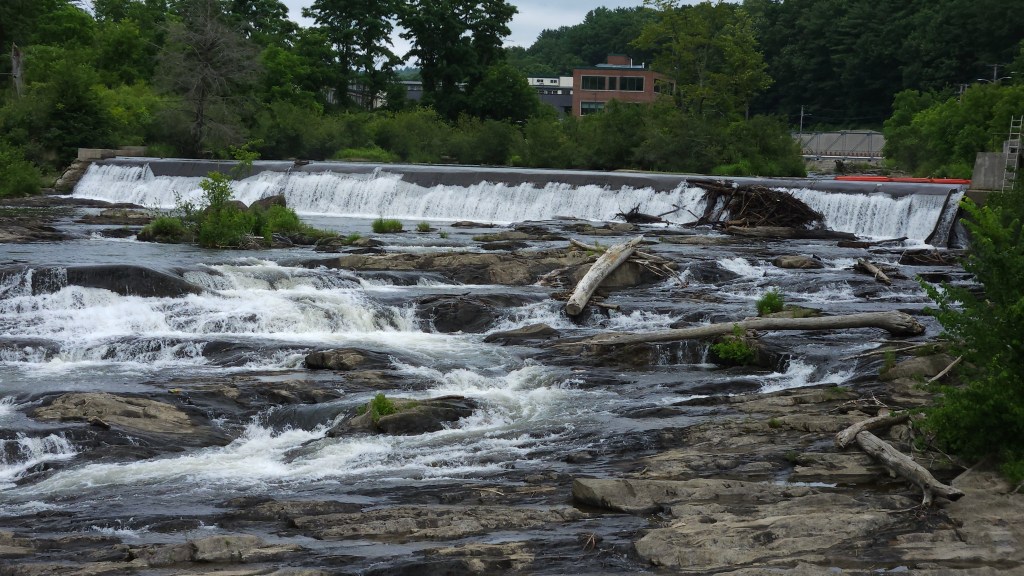
Black River Falls, VT

Over thousands of years, water has slowly created its own path – our rivers, creeks, streams, they all are a result of hundreds to thousands of years of erosion. Water has created canyons of massive beauty where millennia of rock formations are exposed and we can see the history of the earth. We can see where water flowed around obstacles more resistant to erosion to find an easier path.

The year 2025 also has shown us the power of water that does not flow peacefully over millennia but that comes in a single storm or multiple storms seemingly back-to-back. Building on prior years, including 2024 with Hurricane Helene that devastated Western North Carolina in a place that was thought to be safe from tropical storms, this spring and summer has brought as-yet uncounted amounts of damage and now hundreds of deaths.

This post is not to finger point, but to remind us all of the force of water and the need to be aware.

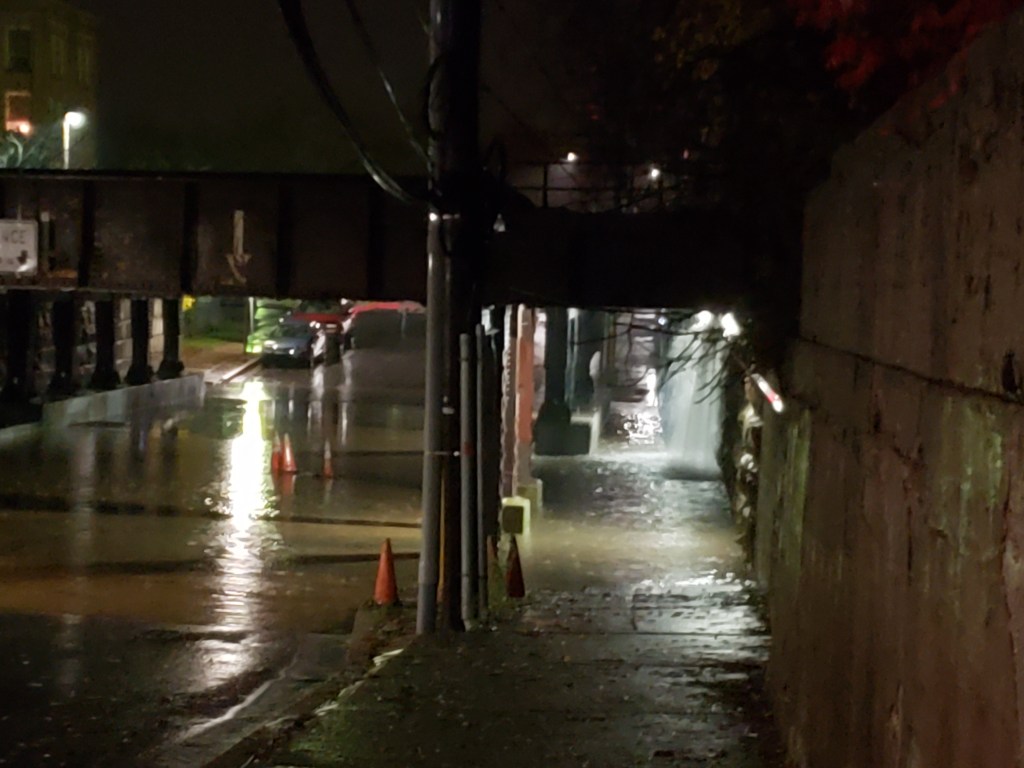
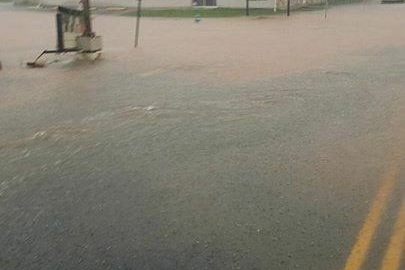
Middletown, PA Underpass filling with water (on right) flowing above along railroad tracks. October 2019
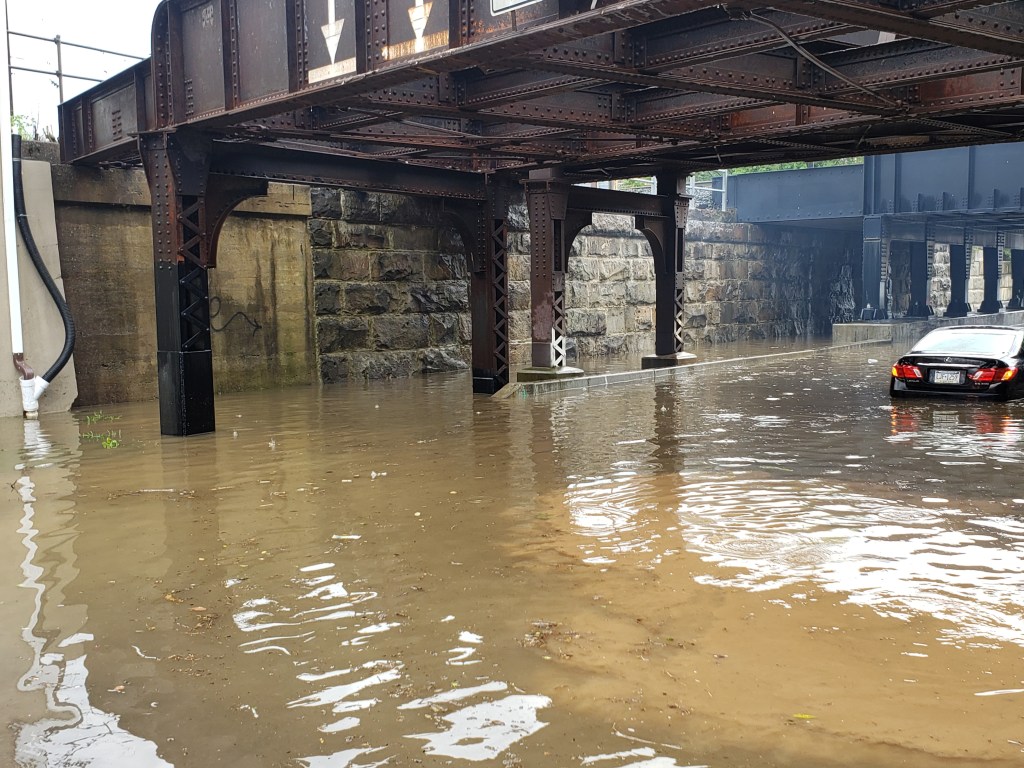
Underpass with water and stranded car. July 2021.

No one chooses to be stranded. Some may make an unwise decision to try to beat the water. What we all need to remember is the power of water. We need water to live, but we must respect her. We may need to quickly get out of her path.

There are many investigations around the world into the issues around flooding and how we can better reduce the risk and warn the people. Smart people will bring forward sound solutions that we can choose to (or not) invest in.

This month, too, we mourn those who were lost.

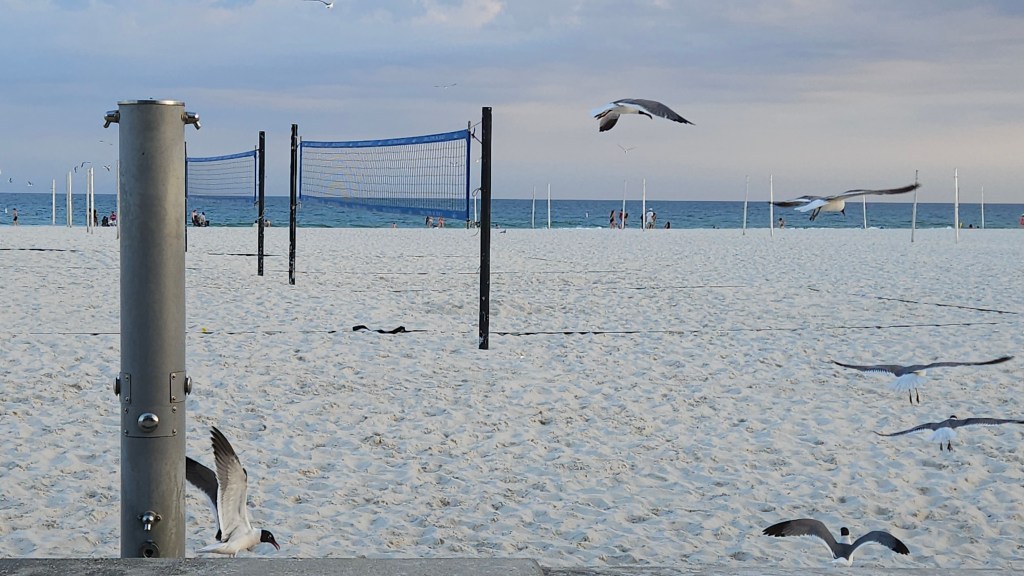
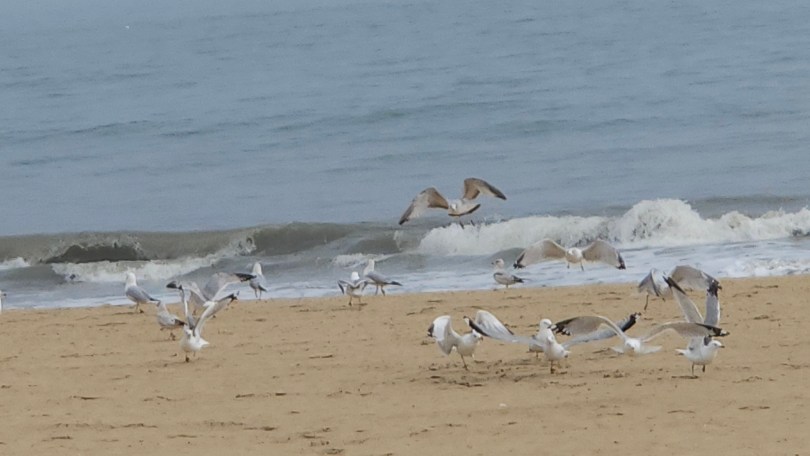
Gulls disturbed by humans.

Water as my Spirit Element

For one of the years I lived in New England, I lived in a little town called Hull. Hull is a little spit of land that divides Mass Bay from Quincy Bay. And it didn’t matter how stressful my day was, as I came around the curve into town, I could see the waves ebbing and flowing in. Just a reminder that the stresses of the day are trivial – no one will care about them after I’m gone.

Since then, I’ve returned to the water again and again. I need to see the infinity of the horizon – to not see land on the other side.

Today, walking along the ocean, I see a little girl running up to a flock of gulls and trying to scare them off. She’s not old enough to be in school. And she thinks it’s fun to have them fly off. But is this not a metaphor for what humans do when we develop land that is unspoiled? We tell the animals and the birds and the insects and the water that we are here now and everything must either leave or conform.

When will we learn to live with nature?

But We Just Had a Storm of the Century Last Year!

C’mon. You know you’ve done it. We’ve ALL done it. So fess up.

You’ve watched hours and hours of coverage of the Storm of the Century on the Weather Channel. You’ve drooled over the satellite imagery with the perfectly formed hurricane eye. And you’ve definitely rooted for the hurricane to move closer to the coast so that the whole eye shows up on the land-based radar.

Storms of the Century are great to watch … from afar through your TV set or now your computer monitor or your phone or iPad.

You likely have experienced one. And now you’re thinking you are safe. It won’t happen again in your lifetime, much less during the life of your mortgage. Um, no.

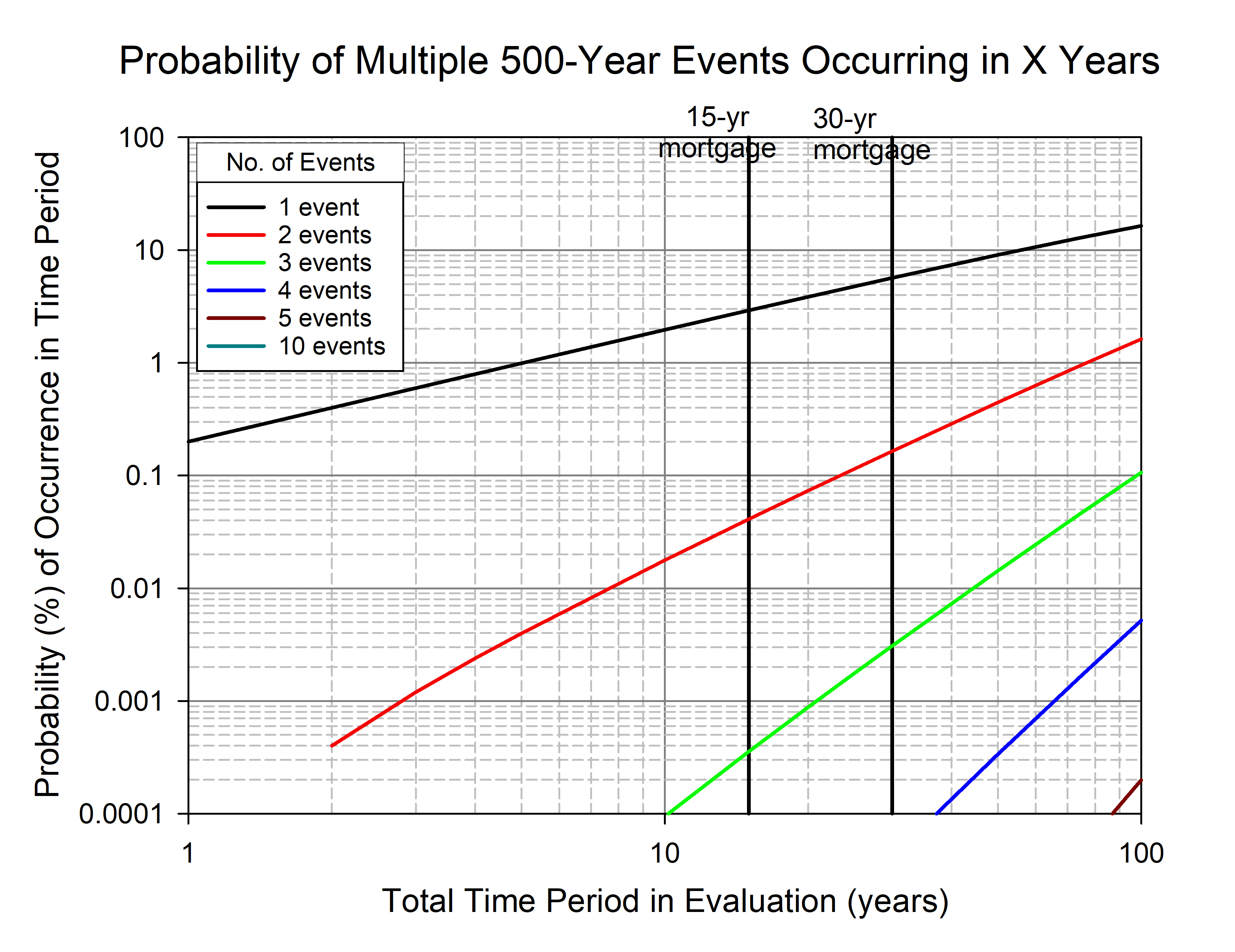
Storm of the Century doesn’t mean that the storm will occur once every 100 years. It’s a risk number. It means that there is a 1% chance of a storm of that size and duration (it’s a combination) will occur in any year. (1% = 0.01 –> 1/0.01 = 100-year storm; that’s how the math goes). A 500-year storm is a storm (rain depth and storm duration combination) that has a 0.2% chance of happening in any given year.

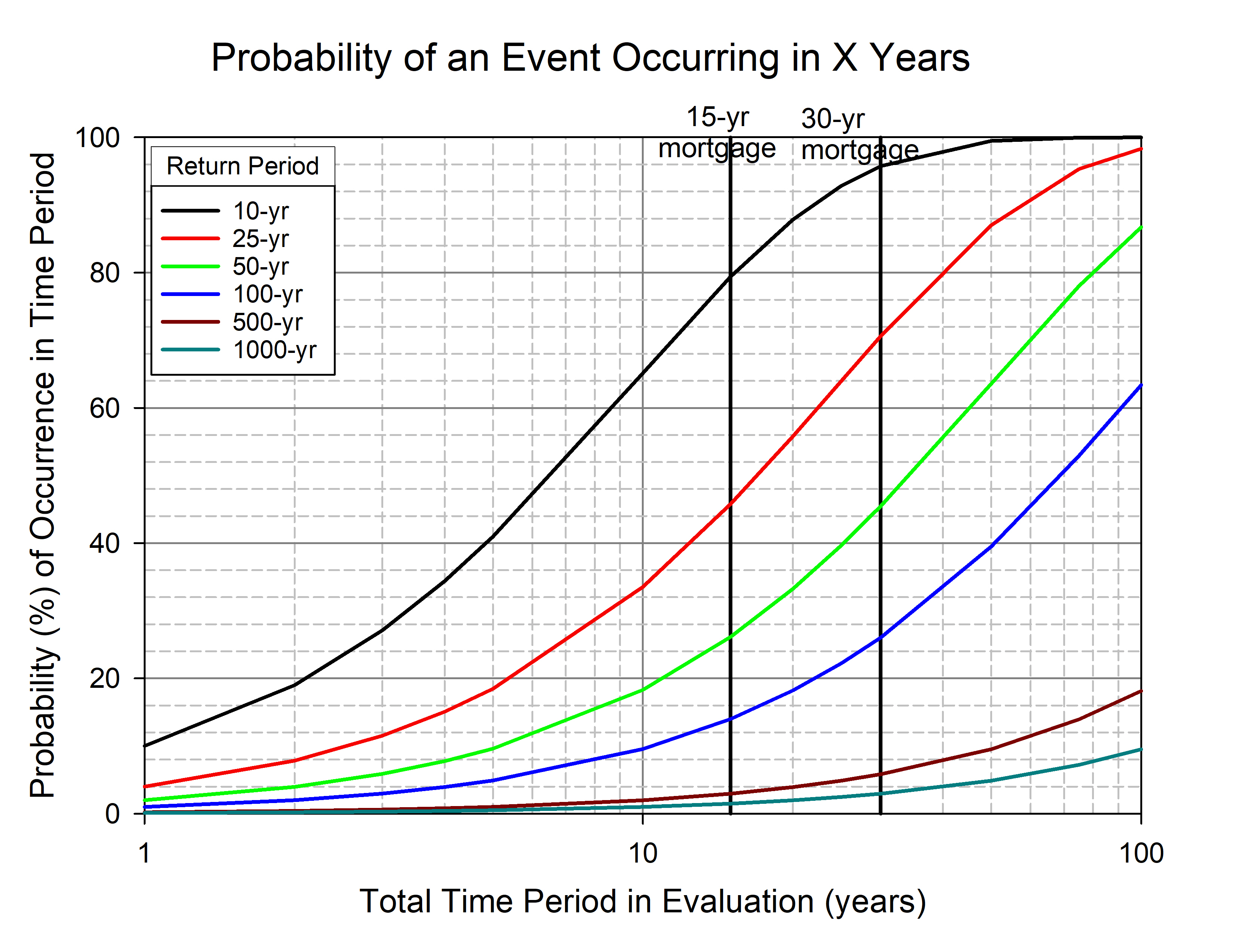
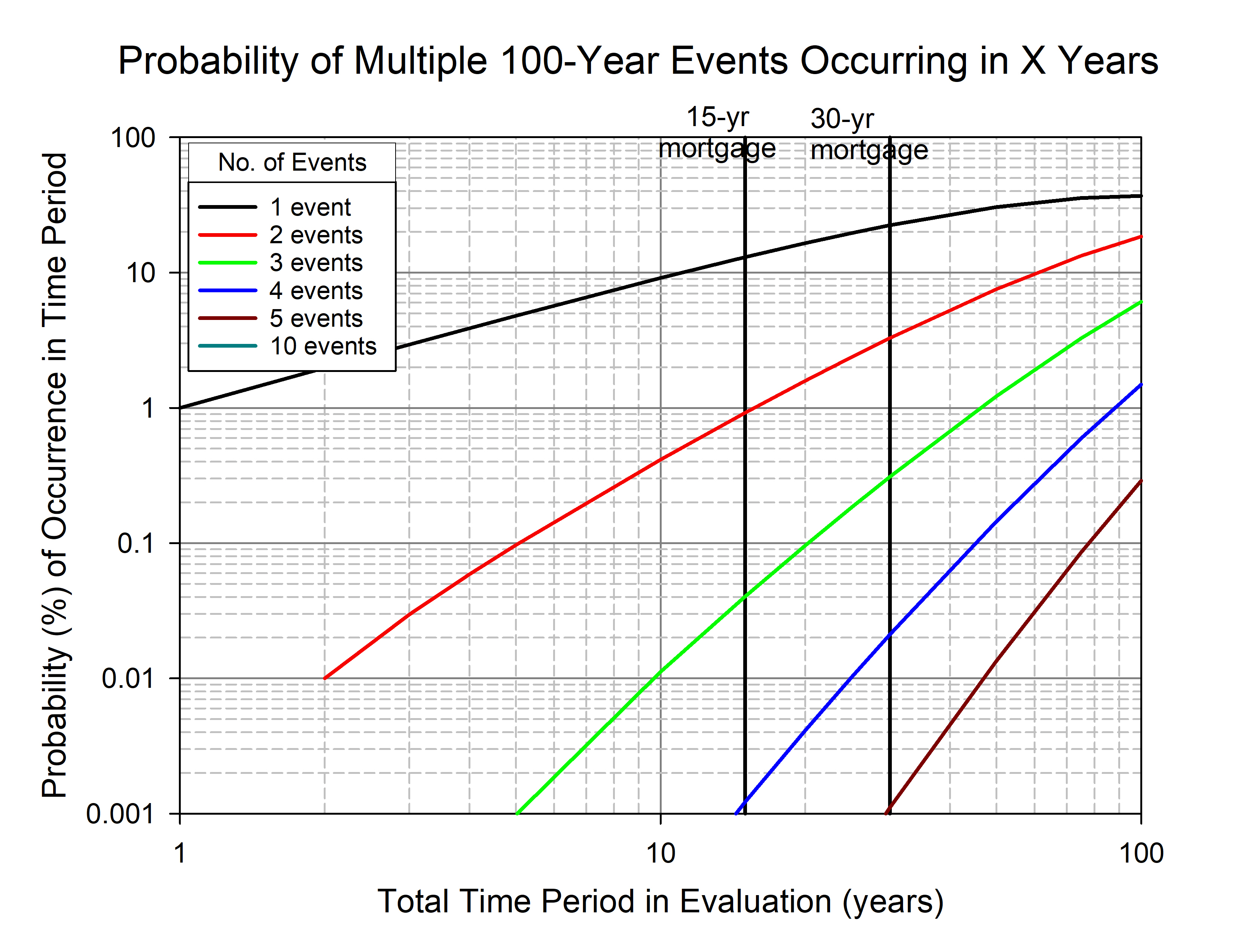
But that’s the probability in any one year. What about the chances of having one of these unlikely events during my mortgage life? As the graph below highlights, the likelihood of having a 100-year storm (1% probability of occurrence in 1 year) in the duration of a 15-year mortgage is about 14% and in my 30-year mortgage it is about 26%. For the 10-year storm, which is used as the storm size for sizing stormwater pipes in my borough, the likelihood of that system “failing” by being full and ponding in the streets is 80% during a 15-year mortgage time frame and almost 96% during a 30-year mortgage.

probability of extreme event in total number of years

Time to take a breath, though, and remember that the storm sewer system being full does NOT mean that I should look for an ark and trying to gather up the animals two-by-two. A 10-year storm has a 10% chance of happening in any year. It’s a common storm and it is one where having a storm of that size usually results in a little bit of street flooding – maybe the entire road is under less than 1 – 2 inches of water.

It’s the rarer storms – the 100-year and 500-year or 1% and 0.2% storms – that will cause more damage and more likely to have people die due to flooding. In my borough, we’ve had 2 500-year storms in the last 6 years. Yes, that’s right. TWO 500-year storms in 6 years. Yes, the fact that a rare storm occurred one year does not stop it from happening again … and soon. And we can calculate that too! The chances of having 2 100-year storms (# of events = 2; red line on graph) in 6 years is slightly more than 0.1%, in a 15-year mortgage is 1%, and in a 30-year mortgage is about 3.2%. Still rare, but not THAT rare.

multiple events 100yr stormmultiple events 500yr storm

Well, we got 2 500-year storms in 6 years (Tropical Storm Lee in 2011 and a microburst storm in 2017). How likely is that? 0.006%. In a 15-year mortgage, the likelihood is 0.04%, while in a 30-year mortgage, the likelihood is 0.18%.

What does this mean to me? Consider flood insurance, even though I don’t live in a FEMA floodplain. (Urban flooding is material for a future post).

And we are just darn unlikely. We had 2 rare events in 6 years and that likelihood was 0.006%. Someone find the broken mirror or black cat or spilled milk. Fix our luck!

Rain Tax?? No, It Is a Development Fee

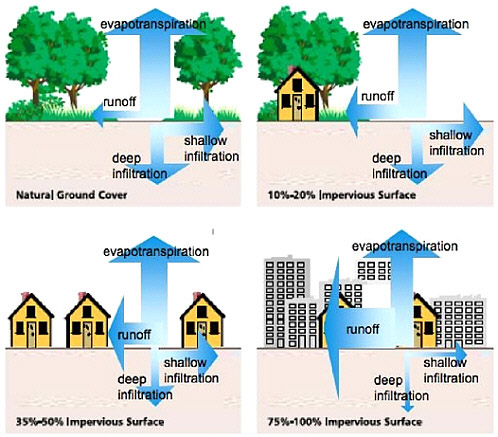
My borough is thinking about an annual development fee. We have water quality issues and we have flooding issues. Some people call it a rain tax and wonder why we are taxing the rain. We are not taxing the rain. We are assessing a fee for how much you disturbed the land and interrupted the water cycle. When this was Penn’s Woods, most rainfall was returned to the atmosphere via the trees. Then we cut down the trees to put in farms and houses. And then more houses. And then other buildings. We removed the trees – those organisms that pumped the rain back to the atmosphere.

Stormwater EPASource: US EPA

We also paved over a lot of the land so we could drive on it or park our cars at work all day on it. We needed compacted soils for our buildings, but for simplicity, we just compacted the entire development area. Now we have removed the pumps, we have blocked the soil from receiving the moisture it used to get, and we wonder why we flood.

Picture1

So, that’s not a rain tax. It’s you paying for the impact that you have on the land, on the floodwater generation, on the transport of pollutants such as your fertilizers and pesticides, the oil from your car, and, yes, even your dog poop.

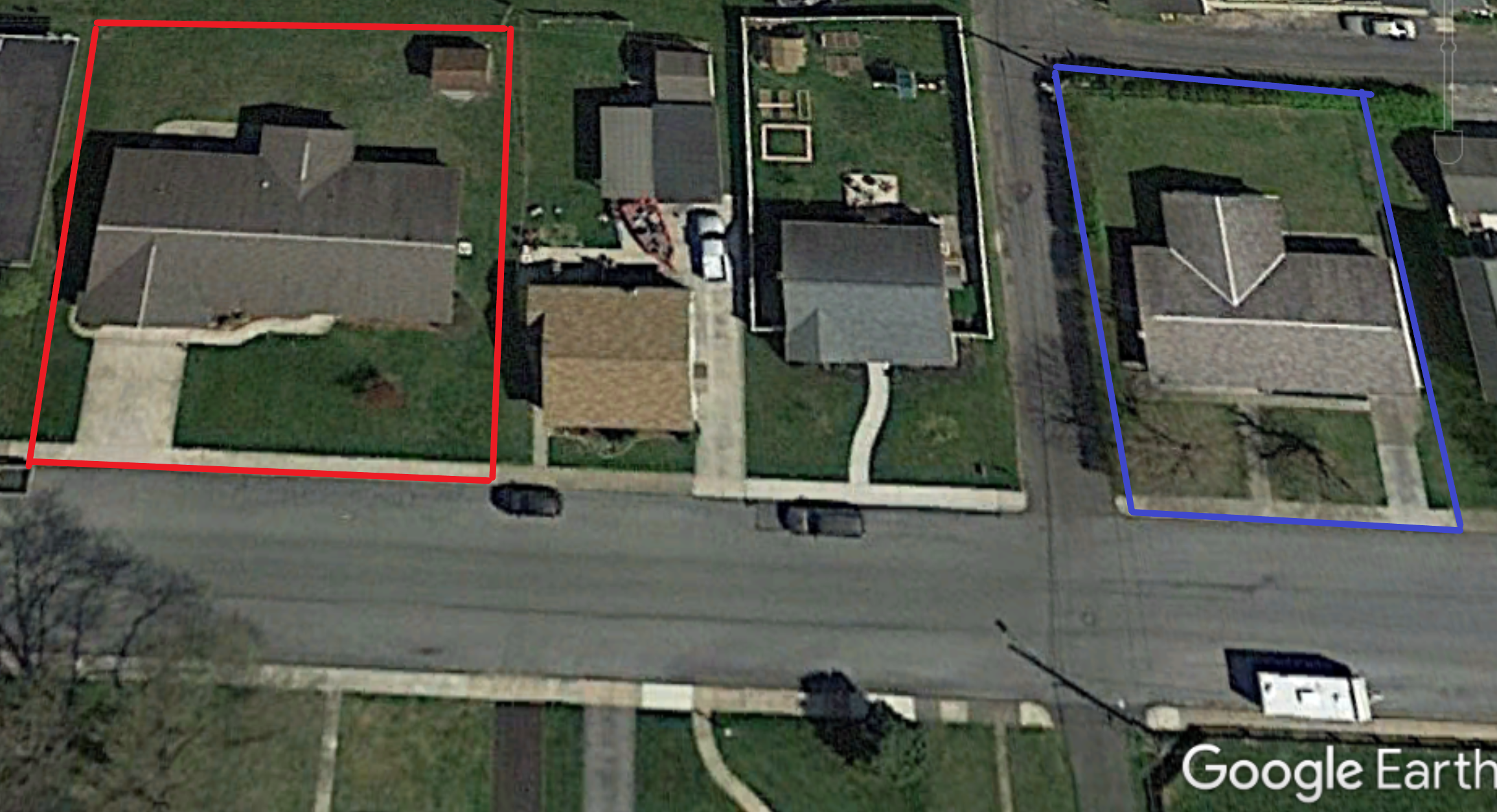
Every year, your property and how it is developed impacts the water. To illustrate, here are two lots and houses on the same street and a quick calculation of impervious area (areas where water can’t seep back into the soil where it belongs). The house+garage in the red is approximately 3,000 square feet while the house+garage in the blue is 1,700 square feet, plus the house in red has a larger driveway and sidewalk.

lot comparisons

Therefore, using the graph above, the 1,700 square foot house space (if the house wasn’t there and the soil was healthy), would generate approximately 53 gallons of runoff, but the house roof creates 1,000 gallons of runoff. The 3,000 square foot house space pre-development would generate 94 gallons of runoff and, after the house blocked the soil, would generate 1,770 gallons of runoff. Almost twice the size results in almost twice the runoff. Most importantly, covering up the soil results in almost 20 times more runoff than the undeveloped property. That runoff has to go somewhere and someone has to pay to keep the system maintained and periodically replaced. Your house, your choice of impact. That’s why most fees are based on impervious area, although it is easier to calculate it based on property value. Now, check to see if you can get a credit for being a good steward and improving what you can so you can keep the stormwater you generated on your own property and reduce flooding.


One Water … Restoring the Circle of Life

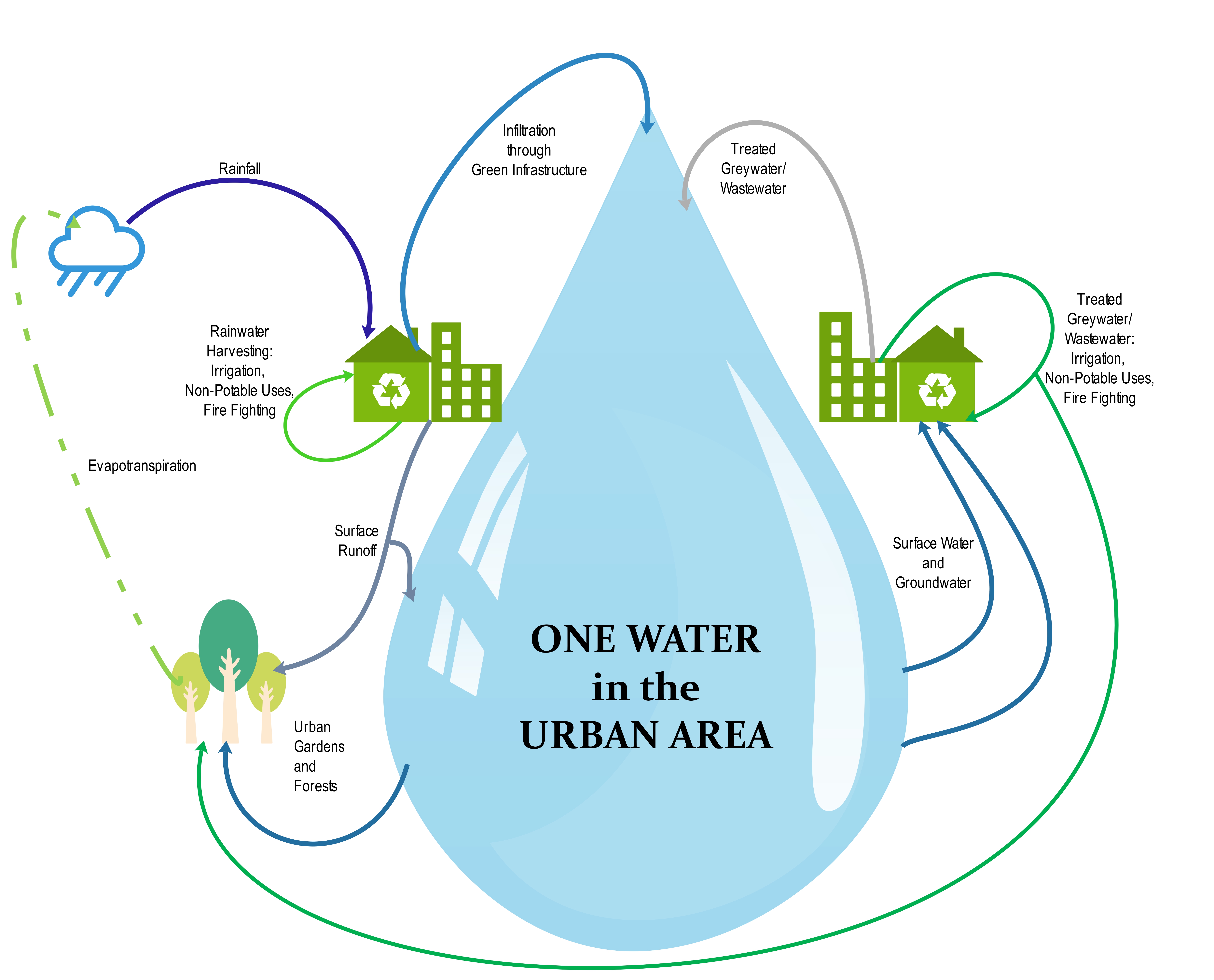
Modern times – the era of efficiency – always pushing for improving our way of life. But … it has resulted in a disconnect from the water cycle. We go into our houses and turn on a tap and we get a glass of refreshing water. Later, we flush our toilets and that wastewater magically is transported away from us. In a hard rain, the runoff passes over the grass and into the street until it finds an open grate and dumps into a pipe to go ‘who knows where’.

As our cities developed, drinking water, wastewater, and stormwater became three separate processes, often with three separate city managers. We broke the cycle of life by continuing what our recent ancestors taught us – bring water in and then once it is dirty or a nuisance, move it away as quickly as possible. We broke from the tradition of recycling water.

Now, as cities and regions experience water shortages and as treatment plants are overwhelmed due to population growth and aging infrastructure, innovators are thinking about restoring the balance. One Water. One Life.

one water in the urban area

(C) Copyright. Shirley Clark. 2019.

Wastewater and stormwater are no longer nuisances – they are opportunities waiting in the wings. Current uses for drinking water are evaluated to see which ones require potable water and which ones do not. Then, where we do not need potable water, these innovators propose replacing potable water with nonpotable water – either from treated wastewater or stormwater.

These opportunities come with nicknames, such as “purple pipes” that describe the pipe color that was originally used to designated systems carrying treated wastewater to outdoor irrigation uses such as golf courses or urban parks or even to houses to water their lawns. “Rainwater harvesting” to explain the process of reaping the rainwater on a roof and storing it for landscape irrigation or for toilet flushing.

Technologically, we can implement these opportunities. What we have to find in ourselves and in our communities is our will to treat water as the source of life – a precious resource. How to do this is the question?? How do we convince our neighbors that treated wastewater is safe for lawn irrigation or toilet flushing? How do we convince our building owners to capture rainwater from the roof and use it at their sites for irrigation or cooling towers or flushing toilets? What are our opportunities in older cities and older buildings?

Most importantly, how do we connect our children to the water so that they ask for what we did not – One Water, the fountain of life?

We, the Humans, Tame Mother Nature … Or Do We?

Middletown, PA, the oldest borough in Dauphin County, Pennsylvania, at 250+ years old, nestles at the confluence of the Susquehanna River and the Swatara Creek: Morphing from indigenous settlements through a farming community through an industrial boom to now – a small town adjacent to the second-largest campus in the Penn State University system. Each new life has brought new water challenges with historical decisions affecting the present.

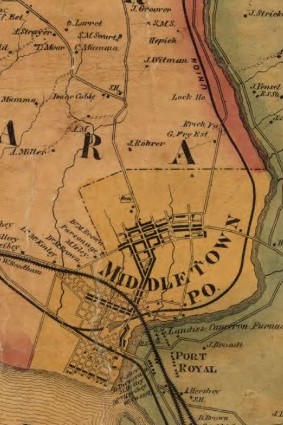
Historical maps (such as the Dauphin County 1862 map below) tell the story of the two streams that run through the borough. Water was the source of life and food and a workhorse to support industrialization.

1862 map11 middletown isolated cropped

Map #76 – Map of Dauphin County, Pennsylvania, 1862. A. Pomeroy Publisher, 517, 519 & 521 Minor Street, Philadelphia, 1862. Obtained from the Pennsylvania Historical Museum Commission. http://www.phmc.state.pa.us/bah/dam/mg/di/m011/Map0076Interface.html


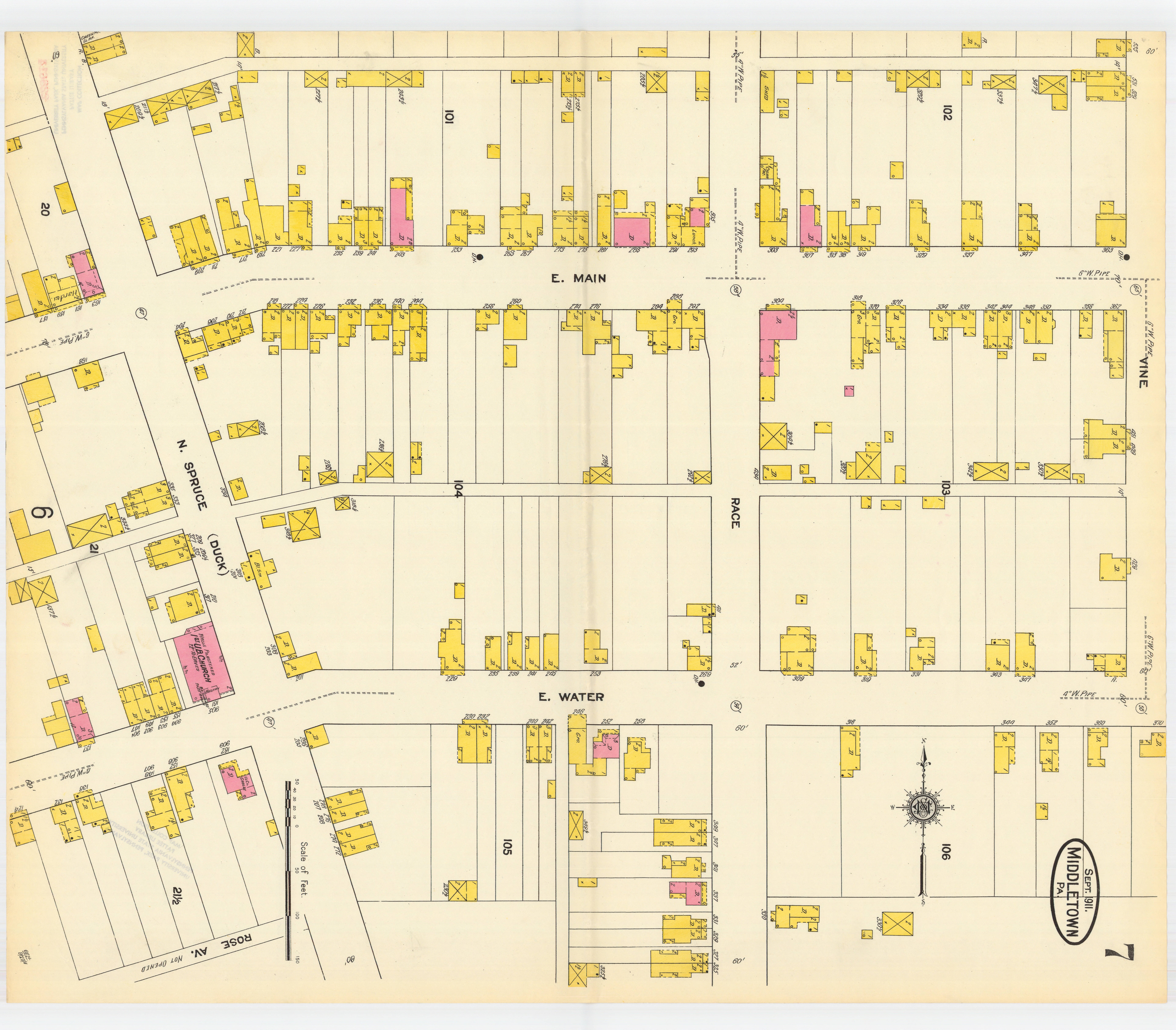
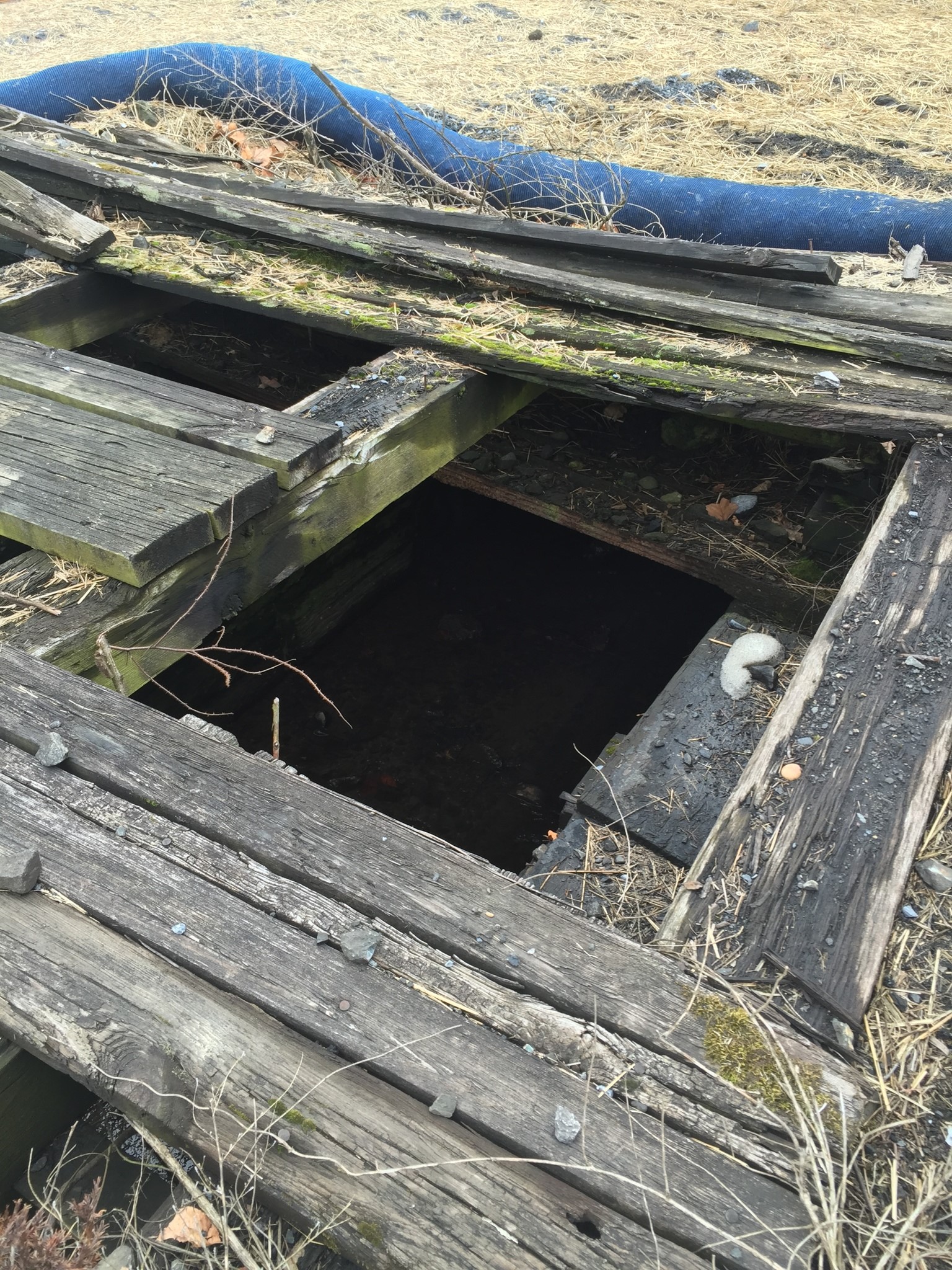
But at some point, the water became a nuisance to the residents and the visible streams disappeared (below, 1911 Sanborn Fire Maps of Spruce (Duck) St with no visible streams). Streets and houses replaced the water and forced the water underground.

maps1_14221_full sheet 7

1911 Sanborn Fire Maps. Obtained from the Penn State University Libraries. https://digital.libraries.psu.edu/digital/collection/maps1/id/14224/rec/3

covering of stream piping brady myers 2019

Underground streams throughout the watershed. Photograph by Brady Myers. Permission granted for use. Copyright by Brady Myers 2019.


Out of sight became out of mind, until 4.7 inches of rain fell in an hour in July 2017. The streams reminded us of their presence as they flowed above and below ground – filling the pipes and people’s yards and houses.

main street flooding 2017

Stream above ground. Photograph of July 2017 flash flood.

What we thought we had tamed and buried laughed in our waterlogged faces. Now we know that we did not “win”. We did not tame Mother Nature. She won. She always wins. “Respect the water,” she whispers to us from the top of the floodwaters rushing by. Always respect the water.”


What does rainwater have to do with buying a house??? The almost house.

Like my co-writer, my significant other and I have decided to move on to the next stage of our lives and buy a house to grow old in. Growing up in NYC, I never ever imagined I would live in Pennsylvania, let alone in Amish country where farmland is prevalent. But, over the years, I find myself yearning for a more isolated life, away from neighbors and city life (even though where I live is not nearly as populated as surrounding bigger cities as like Lancaster and Harrisburg.

Finding something in the country turns out to be harder than we thought. I was sad to miss out on seeing a house with thirteen acres but it would have been too far to drive to work. We did find a place that was just over an acre but it was not without its problems. I don’t have any photos but I can say that this place would have given a number of discussions for this post.

As I walked the land, I saw that this backyard, as well as surrounding neighbors’ yards plus the street, sloped downward into one spot where the drainage leads to. Seeing a willow tree, I guessed there was probably an area nearby, if not at that spot, that gets enough water to sustain the willow. It turned out that corner of the lot pools surface water in heavy rain for about a day. For me, that sounded like a perfect area to install a rain garden and take care of that little problem. (Yay! Master’s degree at work!) I also looked at the areas where the rain gutters from the house came out and looked for enough room to make rain gardens to take up the water coming off the roof instead of the water rolling off the hillside and into that corner of the lot.

I was happy to see that the driveway was gravel and not paved. Why is this important? It means that water has a chance to drain downward into the ground to filter and eventually recharge the water table instead of being swept away to the nearest stormwater drain, towards the house or garage (depending on ground slope), or just pooling where it is. I admit I did a tiny happy dance inside.

The expanse of land was what caught my eye at this house, more so than the house itself. I am planning on growing a food forest (a discussion for another post) and it would have been interesting to transform this land that is pretty much all lawn, which also has a septic tank and drainfield on part of it. Whether I was growing a food forest or not, I had plans to rip out the lawn. “What?” you ask. “Are you crazy?” Nope. Doing this and replacing it with native plants such as grasses, sedges, flowers, trees, and bushes gives us so much more in value.

1.) A smaller water need for native plants and natural resources (aka, gasoline to mow a lawn, trim edges and hedges, whack weeds) means a smaller environmental impact. Lawns have to be constantly watered and maintained. They have to be mowed (a societal belief because having a tall lawn is unacceptable, but I won’t go there). They have to have fall leaves blown into piles with leaf blowers. (Leaves are yet another discussion for another day.) I hardly see anyone rake up leaves nowadays.

2.) To make lawns nice and pretty (to society’s standards, not mine), they need to be weeded and fertilized. This means breaking out the herbicides, pesticides, and fertilizer. Sometimes, they are used right before a rain storm. Can anyone guess where they end up?

3.) Lawns are a monoculture, meaning it’s a single species. This means less diversity for beneficial insects to thrive on. Native plants and just having a diversity of plants in general not only help keep the insect population thriving, the insects and birds help to pollinate the surrounding area. And, whoo hooo! This leads to a nicely functioning ecosystem at various levels: above the ground, at the ground level, and below the ground, in the soil.

4.) Lawns are not as effective in improving soil health as compared to varied plants growing on the same plot. There is a lack of biota diversity within the soil and soil does not function well.

5.) Planting natives and, in my case, I was thinking of planting salt-tolerant native species, along the road where the lawn meets pavement helps take up surface runoff and road salt.

All in all, who would have thought so much goes in to buying a house?! And this isn’t even the normal issues like having a good foundation, water leaks, septic tank issues, and electrical problems, not to mention a potential radon issue we weren’t thinking about. Actually, all of these “normal” issues just listed were going on in the house we were looking at and very close to purchasing. Alas, we are on the hunt again. On to the next set of potential stormwater issues and fixes! =D
Odorless, Colorless, Tastelesss Gases May Not Be Our Friend

Yes, I know that this is not a water post, but this is the first anniversary of the passing of the husband of a great friend of mine. He was much too young when he, a non-smoker, was stricken with lung cancer and the world lost a great man. This post is to honor him and to help others find information on radon. The Department of Environmental Protection has some great ads recommending that people have their homes tested, but seriously, except for the Super Bowl, how many of us watch the ads?

We’ve known that increased radon concentrations have been associated with increased lung cancer rates in uranium miners. However, until 1984, we believed that the danger was primarily associated with miners and not with the general public. Stanley Watras, an engineer working on the Limerick Nuclear Power Station, tripped the radiation alarms at the power plant (some stories say as he entered the plant, others say as he leaves – I was in college and focused on studying so I don’t remember). None of his co-workers was tripping the alarms and no leaks were detected. Mr. Watras, however, was highly radioactive. So where did this come from? His house!

Mr. Watras’ house in Boyerstown, PA, sat on the Reading Prong, which contained radon-bearing rock and the radiation leaked into his home. Estimates are that he was exposed to the equivalent of 200,000 chest x-rays a year (YES, 200,000 chest X-rays PER YEAR). Uh-oh. At that point, the US EPA realized that this was a potential health problem to the general public. (https://spea.indiana.edu/magazine/Spring-2016/articles/barnes_stanley_radon.shtml)

You’re thinking – ok, that’s not great. Now what? You can check for the radon measurements in your town too. This won’t tell you what is in your house but it will tell you if there is something to have investigated. The main page for the PA DEP on radon is http://www.dep.pa.gov/Business/RadiationProtection/RadonDivision/Pages/default.aspx. And on this page, you can find a link at the bottom to the radon test data by zip code: http://www.dep.pa.gov/Business/RadiationProtection/RadonDivision/Monitoring/Pages/default.aspx.

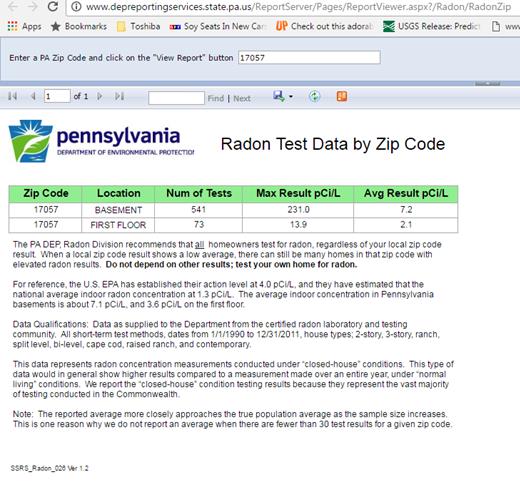
As I said, I’m in the process of buying a house in Middletown and as part of the pre-closing inspections, I had a choice of adding radon testing to the proposed agreement. I had looked up the zip-code based data and found the following information.

radon


The recommended level is less than 4 pCi/L. The first floor of the buildings tested were fine on average, although at least one result exceeded average. However, the basement average exceeds the recommended limit and my washer and dryer are in the basement and I’m thinking about finishing part of the basement in the next few years (hello, woman cave!). So yes, I want radon testing!

I don’t have any results to post because the seller didn’t want it done while they still owned the house (legal liability, if known). I did agree to that stipulation and my home inspector will return in January at the same price for the inspection as he would had it been done with the general house inspection a couple of weeks ago.

I’m not using a home test kit to do it because some of the test kits are not reliable and I want a professional evaluation. So we’ll do it in January when the ground is frozen and/or wet and most likely to trap the radon. It should give me a feel for the maximum radon in the house. And then I can sleep better knowing if I need to install a basement ventilation system for the radon.

Ced and Andee, this is for the two of you.

House Hunting in Middletown after Tropical Storm Lee

I’ve decided to be an adult and accept that I am in southcentral PA until retirement. So the next step of adulthood for me is buying a house. I had only a few criteria for my house: (1) Big enough for all my books but small enough to clean, (2) Within walking distance to work, and (3) Not in the Tropical Storm Lee flood area. I have been working with a great real-estate agent who tolerates all my engineering quirks, which means that I don’t waste her time going to houses that I know won’t work.

So what does Tropical Storm Lee have to do with all of this? First, if TS Lee can happen once in the 13 years I’ve lived here, then it could happen again. I have at least 15 years before retirement. We seem to have more extreme rain cycles over the last few years (more dry days followed by more intense storms). When I moved here, I could see across the street at work during a rain storm. Now there are southern gullywashers where, for a few minutes, all I can see is the rain. I see much more flash flooding where the gutters and inlets can’t keep up with the rain. TS Lee first had flashflooding (which easily could happen anywhere in any town) and then river flooding as the crest moved down the Swatara Creek. It is the river flooding I am avoiding.

I had gone back and forth on a house because it was on the border of the flood zone. One older map said no and one newer map said that a corner of the property may touch the flood zone (you can check your location in PA here: http://www.pafloodmaps.com/homeowners-tenants/Pages/default.aspx#.WCeKHWorLIU, then find the link part way down the page that says Flood Risk Application Tool). In the area of Middletown where I was house-hunting, here is the map. So as cute as some houses were, nope. Yes, you can buy a house in a floodplain. Yes you can build in a floodplain. However, even with the rules in place for special requirements to build in a floodplain, I think we are incredibly foolish to build new structures in areas that Mother Nature intended to use to soak up water into the ground, replenishing groundwater and hopefully keeping it out of the streams, which reduces flooding.

fema-map

I looked at this map again and I realized that this map, which was in production during TS Lee, put TS Lee flooding levels in the 100-year to 500-year floodplain (a 100-year storm is one that has a 1% chance of happening in any year, while a 500-year storm has a 0.2% chance). Many areas that are slightly outside or on the edge of the the 500-year floodplain were flooded. I walked the town and I saw this (missed the peak of flooding because it occurred overnight).

Mill St. Flooding levels between 100-year and 500-year floodplain (Moose Lodge Parking, September 8, 2011 [left]; Mill St High Water Mark, September 9, 2011 (center); Mill St under water, September 9, 2011 [right])

Race St Flooding by Hoffer Park. Left: September 8, 2011; Right: September 9, 2011 (with a large increase in the inundated floodplain)

Left: Flooding behind houses on Emaus St.; Right: PA 230 at Swatara Creek bridge underwater.

A storm, that was not a 1% chance storm by definition, caused flooding that had between a 0.2 – 1% chance of occurring. And those aren’t odds I’m willing to live with, given the changes I’ve observed in the rainfall patterns. I’ll be in my new house, high and dry.

More to come on why TS Lee overwhelmed the drainage system in a slightly more technical, non-technical way soon!